نظام ذكي للتوصية بالمحاصيل بناءً على التربة والبيئة
Crop Recommendation System Based on Soil and Environment
A smart crop recommendation system that predicts the best crops based on soil nutrients and environmental data such as temperature, humidity, pH, and rainfall, ensuring sustainable farming and higher crop yields.
Project Overview
The Crop Recommendation System is an intelligent agriculture solution designed to help farmers and agricultural experts select the most suitable crops for their land. By analyzing soil nutrients (Nitrogen, Phosphorus, Potassium) and environmental factors such as temperature, humidity, soil pH, and rainfall, the system provides accurate, data-driven crop recommendations that improve productivity and promote sustainable farming practices.
Key Features
Multi-Input Data Collection
- 🌱 Collects soil nutrients (N, P, K) and environmental data.
- 🌦️ Includes temperature, humidity, pH, and rainfall inputs.
Advanced Crop Prediction Algorithm
- 🤖 Uses machine learning models for accurate crop recommendations.
- 📊 Analyzes complex interactions between soil and climate factors.
Nutrient & Environmental Insights
- 🧪 Explains how nutrients affect crop growth.
- 🌍 Provides insights into environmental impact on yield.
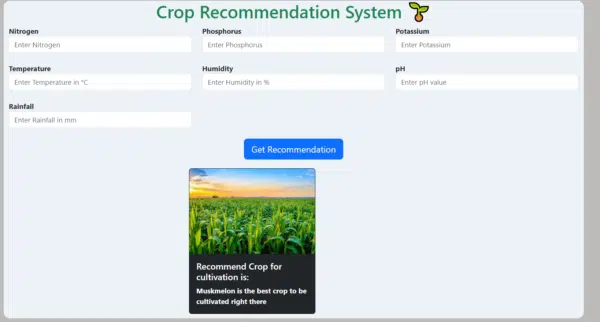
User-Friendly Interface
- 🖥️ Simple interface for data input and results.
- 📈 Easy-to-understand crop recommendations.
Sustainability & Yield Optimization
- 💧 Optimizes water and fertilizer usage.
- 🌾 Improves crop yields with minimal waste.
- ♻️ Promotes eco-friendly farming practices.
Technology Stack
- 🐍 Programming Language: Python
- 📊 Machine Learning: Scikit-learn
- 📈 Data Processing: Pandas, NumPy
- 🌐 Input Data: Soil & Environmental Parameters
- 🖥️ Interface: Web or Desktop Application
Use Cases
- 👨🌾 Farmers – Select optimal crops for higher yields.
- 🌱 Agricultural Consultants – Provide data-driven planting advice.
- 🏛️ Government & NGOs – Support regional agricultural planning.
Conclusion
The Crop Recommendation System transforms traditional farming into a data-driven process. By combining soil fertility analysis with environmental data, it empowers farmers to make informed decisions, increase productivity, reduce resource waste, and support sustainable agriculture for the future.