نظام ذكي لاكتشاف وتصنيف فصائل الحيوانات
AI-Powered Animal Species Detection System
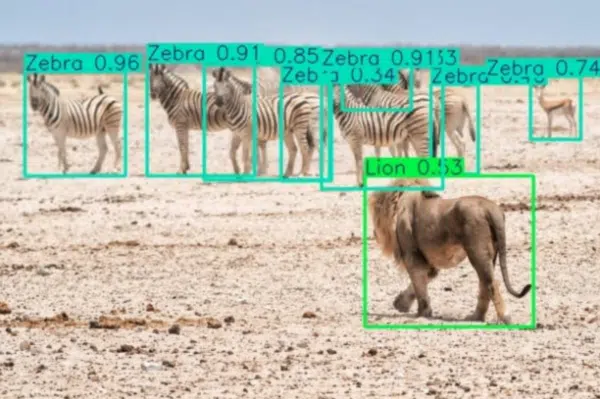
The Real-time Animal Species Detection project is an AI-driven computer vision system designed to detect and classify wildlife species in real time. Using deep learning techniques, it provides fast and accurate identification of animals such as elephants, lions, zebras, and more.
Project Overview
This system leverages advanced deep learning and state-of-the-art object detection algorithms to identify multiple animal species in real time. It is optimized for high-speed inference and suitable for wildlife conservation, security monitoring, and scientific research.
Key Features
Real-Time Animal Detection
- 🐾 Instantly detects animals in live video streams or images.
- ⚡ High-speed inference for real-time applications.
Multi-Species Recognition
- 🦁 Detects and classifies multiple species including:
- 🐃 Buffalo, 🐘 Elephant, 🦏 Rhino, 🦓 Zebra
- 🐆 Cheetah, 🦊 Fox, 🐆 Jaguar, 🐯 Tiger
- 🦁 Lion, 🐼 Panda
Customizable & Scalable Model
- ⚙️ Add or remove animal species easily.
- 📈 Scalable for edge devices and cloud deployments.
Optimized Performance
- 🧠 Powered by YOLO, Faster R-CNN, or SSD.
- 🎯 High accuracy with low false detection rates.
Advanced Customization Options
- ➕ Add new animal species.
- 📊 Train with custom datasets.
- 🎚️ Adjust detection thresholds.
- 🖥️ Deploy on CPU, GPU, or edge devices.
- 🔍 Integrate behavior analysis and tracking.
Technology Stack
- 🐍 Frameworks: TensorFlow, PyTorch
- 🧠 Object Detection: Ultralytics YOLO
- 🎥 Computer Vision: OpenCV
- 🖥️ Hardware: NVIDIA GPUs, Jetson Nano, Raspberry Pi
- 🌐 Deployment: Flask, FastAPI, MQTT
Use Cases
- 🌍 Wildlife Conservation – Monitor endangered species.
- 🚨 Security & Surveillance – Detect animals near restricted areas.
- 🔬 Research & Education – Study animal behavior and movement.
- 🦒 Eco-Tourism & Safaris – Real-time species identification.
Conclusion
The Real-time Animal Species Detection system bridges wildlife monitoring with modern AI technology. Its accuracy, scalability, and flexibility make it a powerful tool for conservation, security, and research. With continuous AI advancements, this system has the potential to transform how wildlife is monitored and protected worldwide.